


Tariffs Are Reshaping Global Trade
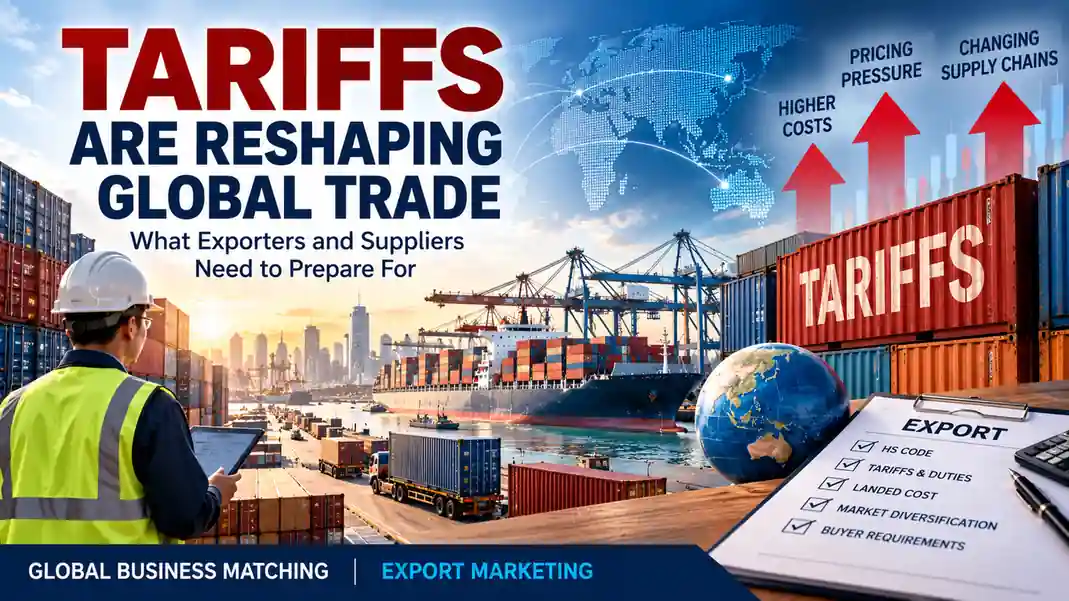
Tariffs Are Reshaping Global Trade: What Exporters and Suppliers Need to Prepare For
Rising import costs are changing pricing, sourcing and purchasing decisions—making market diversification and careful export planning increasingly important.
Tariffs have become an increasingly important factor in international trade, affecting not only importers but also manufacturers, exporters, distributors and ultimately consumers.
For businesses seeking international buyers, the issue is no longer simply whether there is demand for a product. Exporters increasingly need to understand how tariffs affect the final landed cost of their products, their buyers' margins and their competitiveness against suppliers from other countries.
Recent U.S. data provides a useful illustration of how these pressures can move through a supply chain.
Research published by the Federal Reserve Bank of New York in July 2026 found that many small businesses experienced financial pressure related to tariffs during 2025. Among surveyed U.S. goods and retail businesses facing higher imported-input prices, around 80% reported passing at least some of those increased costs to customers, while around 60% also absorbed some of the increase themselves.
This demonstrates an important reality for international suppliers: tariffs can influence purchasing decisions long before a buyer stops importing altogether.
The Impact Goes Beyond the Importer
When tariffs increase the cost of imported products or components, importers have several possible responses.
They may increase their selling prices, accept lower margins, negotiate lower prices with overseas suppliers, change suppliers, alter purchasing schedules or look for alternative sourcing countries.
The New York Fed's research found that U.S. small businesses exposed to higher imported-input prices used a mixture of these strategies, with many both passing costs to customers and absorbing part of the increase internally.
The effect can also continue for some time.
Separate New York Fed research published in July found that 47% of surveyed service firms and 44% of manufacturers that directly paid tariffs expected further tariff-related price increases, indicating that the effects of tariff changes can work through supply chains gradually rather than immediately.
More recent research published by the New York Fed in August and revised in September 2026 also found that tariff effects can extend beyond imported finished products. Imported inputs can increase costs for domestic producers, while reduced competition from higher-priced imports can affect domestic pricing as well.
What Does This Mean for Exporters?
For exporters, particularly SMEs, the changing trade environment makes landed-cost competitiveness increasingly important.
A product that appears competitive based on its FOB price may become considerably less attractive after freight, insurance, import duties, tariffs, customs charges and domestic distribution costs are added.
This means exporters should increasingly understand the economics of the transaction from the buyer's side, rather than concentrating only on their own selling price.
Several areas deserve particular attention:
1. Understand your product classification
Tariff treatment depends heavily on how a product is classified. For the United States, for example, Customs and Border Protection notes that determining applicable duties, quotas and certain trade-program benefits requires knowing the product's Harmonized Tariff Schedule classification.
Exporters should therefore make accurate HS/HTS classification part of their market preparation rather than treating customs classification as something to consider only after an order has been received.
2. Calculate the buyer's landed cost
Knowing your export price is not enough.
Before approaching an overseas buyer, exporters should have a reasonable understanding of how freight, duties and other import costs affect the product after arrival.
This can also make negotiations more productive because the exporter understands the commercial pressures facing the importer or distributor.
3. Protect margins—but remain flexible
When import costs increase, buyers may ask suppliers to reduce prices.
Simply agreeing to every reduction can make exporting unsustainable. Instead, exporters can explore changes in packaging, shipment quantities, product specifications, logistics arrangements or order volumes that could improve overall economics.
4. Diversify export markets
Dependence on one major destination creates additional risk when tariffs or trade regulations change.
Developing buyers across several countries can reduce reliance on any single market and give exporters greater flexibility when conditions change.
For Asian exporters, this could mean evaluating opportunities across Europe, the Middle East, ASEAN and other emerging markets alongside established destinations.
5. Monitor competitors from other countries
Tariffs do not necessarily affect every supplier equally.
If competing products from another country face different tariff treatment, the relative competitiveness of your product can change—even when your own factory price remains exactly the same.
This can create risks, but it can also create new market opportunities.
Tariff Changes Can Create Opportunities Too
Trade-policy changes are often discussed primarily as a risk. For exporters, however, they can also change sourcing patterns.
When buyers face higher costs from an established supplier country, they may begin looking for alternative manufacturers, new sourcing destinations or different product configurations.
That creates opportunities for exporters able to respond quickly with competitive pricing, reliable production, appropriate certifications and professional sales materials.
This is where continuous buyer research and market development become increasingly important.
Waiting until an overseas buyer starts looking for alternatives may mean arriving too late. Exporters that already understand target buyers, distribution channels and competing suppliers are better positioned to approach the market when sourcing patterns begin to change.
From Exporting Products to Managing Markets
The broader lesson is that successful exporting increasingly requires more than producing a good product.
Exporters need to understand the complete commercial environment surrounding the buyer:
Product → Export Price → Freight → Tariffs & Duties → Landed Cost → Distributor Margin → Retail Price → Consumer Demand
A change anywhere in that chain can influence whether an overseas buyer places an order.
For SMEs in particular, international market development should therefore combine buyer identification, market intelligence, pricing analysis, trade compliance, logistics planning and direct buyer engagement.
As global trade conditions continue to change, exporters that understand these factors—and diversify both their markets and buyer networks—will be better prepared to identify new opportunities when international sourcing patterns shift.
About Global Business Matching
Global Business Matching provides international trade information, business opportunities, trade-event coverage and connections between exporters, suppliers, importers, distributors and potential business partners.
For companies seeking international market development and business matching support, visit the Business Matching section of Global Business Matching